_edited.png)
Inherited Retinal Dystrophy: Causes, Symptoms, and Diagnosis
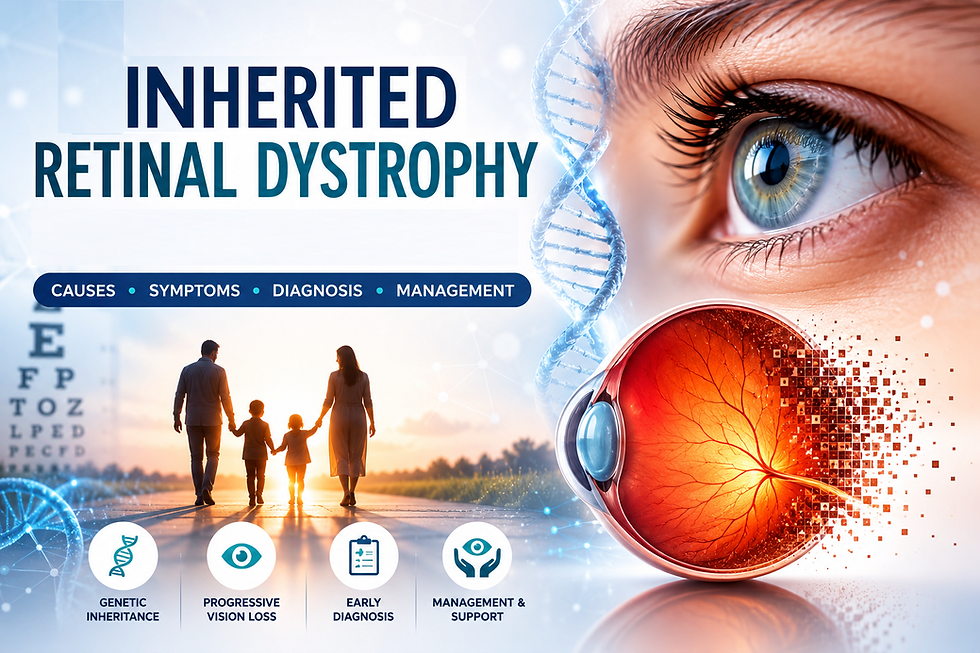
Inherited Retinal Dystrophy (IRD) is a group of rare genetic eye disorders that gradually damage the retina, the light-sensitive tissue located at the back of the eye. The retina plays a crucial role in capturing light and converting it into electrical signals that are sent to the brain, enabling us to see clearly. When genetic mutations affect the normal function of retinal cells, these cells begin to deteriorate over time, leading to progressive vision loss. Depending on the type of inherited retinal dystrophy, symptoms may appear during childhood, adolescence, or adulthood and can significantly impact a person's quality of life if left undiagnosed or unmanaged Unlike common eye conditions such as cataracts or refractive errors, inherited retinal dystrophies are caused by changes in specific genes that are passed down through families. More than 300 different genes have been linked to these disorders, making them one of the most genetically complex groups of eye diseases. While these conditions are relatively uncommon, they are among the leading causes of inherited blindness worldwide. Advances in retinal imaging, genetic testing, and modern treatment options have improved the ability to diagnose these disorders earlier and provide better long-term care. Understanding the causes, symptoms, and diagnostic methods is essential for early intervention and effective management.
What Is Inherited Retinal Dystrophy?
Inherited Retinal Dystrophy refers to a collection of inherited diseases that cause the gradual degeneration of retinal cells. The retina contains two important types of photoreceptor cells known as rods and cones. Rod cells help us see in dim light and provide peripheral vision, while cone cells are responsible for central vision, color recognition, and the ability to see fine details. When genetic mutations affect these cells, they slowly lose their function, leading to a decline in vision over time Several conditions fall under the category of inherited retinal dystrophy, including Retinitis Pigmentosa, Stargardt Disease, Cone-Rod Dystrophy, Best Disease, Choroideremia, and Leber Congenital Amaurosis. Each disorder affects different parts of the retina and progresses at varying speeds. Some primarily affect night vision, while others impact central vision or color perception. Although the severity differs from one individual to another, all inherited retinal dystrophies share the common characteristic of progressive retinal degeneration caused by inherited genetic mutations.
Causes of Inherited Retinal Dystrophy
The primary cause of inherited retinal dystrophy is a mutation in one or more genes responsible for maintaining healthy retinal cells. These genes regulate essential functions such as photoreceptor development, energy production, protein transport, and communication between retinal cells. When one of these genes is altered, retinal cells gradually lose their ability to function properly and eventually begin to die, leading to progressive vision impairment Inherited retinal dystrophy can be passed from parents to children through different inheritance patterns. In autosomal dominant inheritance, only one abnormal copy of the gene is required for the disease to develop. In autosomal recessive inheritance, both parents may carry the defective gene without showing symptoms themselves, while the child develops the condition after inheriting two abnormal copies. X-linked inheritance primarily affects males because the defective gene is located on the X chromosome. In some cases, the mutation occurs spontaneously without any previous family history, making diagnosis more challenging.
Although inherited retinal dystrophy is a genetic condition, maintaining overall eye health remains important. Regular eye examinations and timely consultation with a retina specialist can help monitor disease progression and identify complications that may require additional treatment.
Symptoms of Inherited Retinal Dystrophy
The symptoms of inherited retinal dystrophy vary depending on the specific disorder, the affected retinal cells, and the severity of the genetic mutation. One of the earliest and most common symptoms is difficulty seeing in dim light or at night, a condition known as night blindness. Many patients initially notice that they require brighter lighting indoors or have difficulty driving after sunset. As the disease progresses, peripheral vision gradually narrows, creating a tunnel vision effect that limits awareness of surrounding objects Some individuals also experience blurred central vision, difficulty recognizing faces, increased sensitivity to bright light, poor color vision, slow adaptation when moving between bright and dark environments, or reduced contrast sensitivity. Children with certain inherited retinal dystrophies may develop involuntary eye movements, delayed visual development, or difficulty tracking moving objects. Since symptoms often progress slowly over many years, individuals may not realize the extent of their vision loss until it begins interfering with daily activities. Early recognition of these symptoms is essential because timely diagnosis allows patients to receive appropriate counseling, genetic evaluation, and supportive care.
How Is Inherited Retinal Dystrophy Diagnosed?
Diagnosing inherited retinal dystrophy requires a detailed eye examination combined with advanced retinal imaging and genetic testing. The ophthalmologist begins by reviewing the patient's medical history, current visual symptoms, and family history of inherited eye diseases. A comprehensive eye examination with pupil dilation allows the retina specialist to examine the retinal tissue for characteristic signs of degeneration and identify changes that may indicate a specific inherited retinal disorder Modern diagnostic techniques play a vital role in confirming the diagnosis and assessing disease severity. Optical Coherence Tomography (OCT) provides highly detailed cross-sectional images of the retina, allowing doctors to evaluate retinal thickness and structural damage. Fundus photography captures detailed images of the retina for long-term comparison, while fundus autofluorescence imaging highlights abnormalities in retinal pigment cells that may not be visible during routine examination. Electroretinography (ERG) measures the electrical activity of rod and cone cells in response to light stimulation, helping determine how well the retina is functioning. Visual field testing evaluates peripheral vision, and color vision tests help identify defects in color perception Genetic testing has become one of the most valuable tools for diagnosing inherited retinal dystrophy. Identifying the exact genetic mutation not only confirms the diagnosis but also helps determine the inheritance pattern, estimate disease progression, guide family counseling, and identify patients who may benefit from gene therapy or participation in clinical trials. As research in genetic medicine continues to advance, genetic testing is becoming an increasingly important part of personalized eye care.
Treatment and Management
Although there is currently no universal cure for inherited retinal dystrophy, significant advances in medical research have expanded the available treatment options Management focuses on preserving remaining vision, slowing disease progression when possible, and helping patients maintain independence in their daily lives. Regular monitoring by a retina specialist allows complications to be identified and managed promptly. Depending on the specific condition, patients may benefit from low-vision rehabilitation, specialized visual aids, protective eyewear, and lifestyle modifications that support overall eye health
Gene therapy has emerged as a groundbreaking treatment for certain inherited retinal diseases caused by specific genetic mutations. Researchers are also investigating stem cell therapy, retinal implants, neuroprotective medications, and other innovative approaches that may provide additional treatment options in the future. While these therapies are not suitable for every patient, they represent significant progress in the field of inherited retinal disease management and offer hope for preserving vision in selected individuals.
Conclusion
Inherited Retinal Dystrophy is a complex group of genetic eye disorders that gradually damage the retina and lead to progressive vision loss. Although these conditions cannot always be prevented, early diagnosis, comprehensive retinal evaluation, genetic testing, and regular follow-up with a retina specialist can significantly improve long-term management and quality of life. Ongoing advances in gene therapy and retinal research continue to provide new hope for patients living with inherited retinal diseases. If you or a family member experiences persistent night blindness, unexplained vision changes, or has a family history of inherited eye disorders, seeking prompt evaluation from an experienced eye specialist is the most important step toward protecting your vision and exploring the latest treatment options
If you want to know more details contact us:+91 9625 903017


Comments