_edited.png)
ICL vs LASIK – Which Is Best for You?
Updated: Jul 24

If you are tired of relying on glasses or contact lenses every day, vision correction surgery can be a life-changing solution. Advances in ophthalmology have made it possible to correct refractive errors safely and effectively, allowing millions of people to enjoy clear vision without depending on eyewear. Among the most popular procedures available today are LASIK (Laser-Assisted In Situ Keratomileusis) and ICL (Implantable Collamer Lens) surgery. While both procedures are designed to improve vision and reduce dependence on glasses, they use completely different techniques and are suitable for different types of patients. Understanding the differences between these procedures is essential before making a decision. This comprehensive guide explains everything you need to know about ICL and LASIK, including how they work, who is eligible, their benefits, risks, recovery process, and which procedure may be the best option for your eyes.
Understanding Refractive Errors
Before comparing ICL and LASIK, it is important to understand why vision correction surgery is needed. Refractive errors occur when the shape of the eye prevents light from focusing correctly on the retina. As a result, vision becomes blurred. The most common refractive errors include myopia (nearsightedness), hyperopia (farsightedness), and astigmatism. Traditionally, these conditions have been corrected with glasses or contact lenses, but modern surgical techniques now provide a long-term solution by correcting the way light enters the eye. Both LASIK and ICL aim to achieve this goal, although they do so using entirely different approaches.
What Is LASIK Surgery?
LASIK is one of the most widely performed laser vision correction procedures in the world. During the surgery, the ophthalmologist creates a thin flap on the surface of the cornea using either a femtosecond laser or a microkeratome blade. The flap is gently lifted, and an excimer laser reshapes the cornea to correct the refractive error. Once the laser treatment is complete, the flap is repositioned, where it naturally heals without the need for stitches. The entire procedure usually takes less than fifteen minutes for both eyes, and most patients experience significant improvement in vision within the first 24 hours. LASIK has become popular because it offers quick recovery, minimal discomfort, and highly predictable results for suitable candidates.
What Is ICL Surgery?
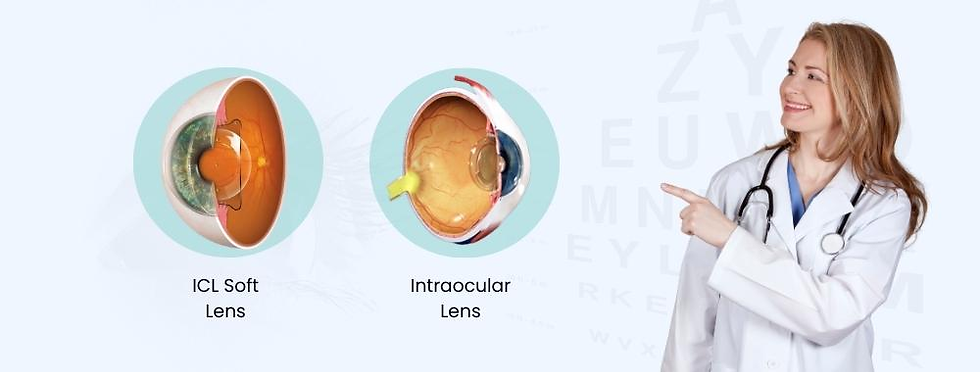
Implantable Collamer Lens (ICL) surgery is another advanced method of correcting refractive errors, but unlike LASIK, it does not reshape the cornea. Instead, the surgeon implants a specially designed Collamer lens inside the eye, positioning it between the iris and the natural lens. The natural lens remains untouched, allowing the implanted lens to work alongside it to provide clear vision. Since no corneal tissue is removed during the procedure, ICL is often recommended for patients who have thin corneas, very high spectacle power, or conditions that make them unsuitable candidates for laser surgery. One of the biggest advantages of ICL is that the implanted lens can be removed or replaced in the future if medically necessary, making it a reversible vision correction option.
How Do LASIK and ICL Differ?
Although both procedures are intended to reduce dependence on glasses and contact lenses, the techniques they use are fundamentally different. LASIK permanently changes the shape of the cornea by removing microscopic amounts of corneal tissue with a laser. This reshaping allows light to focus correctly on the retina. In contrast, ICL surgery does not alter the cornea at all. Instead, it adds an artificial lens inside the eye that corrects the refractive error while preserving the natural structure of the cornea. Because of these differences, the eligibility criteria, recovery process, and long-term considerations vary between the two procedures.
Who Is an Ideal Candidate for LASIK?
LASIK is generally recommended for adults whose eye prescription has remained stable for at least one year. Patients should have healthy eyes, sufficient corneal thickness, and no significant eye diseases that could interfere with healing. Individuals with mild to moderate myopia, hyperopia, or astigmatism often achieve excellent results with LASIK. However, patients with very thin corneas, severe dry eyes, keratoconus, or extremely high refractive errors may not be suitable candidates. A detailed eye examination performed by an experienced ophthalmologist is essential to determine whether LASIK is a safe and effective option.
Who Should Consider ICL Surgery?
ICL surgery is an excellent alternative for patients who are not eligible for LASIK. Individuals with very high myopia, thin corneas, chronic dry eye syndrome, or large pupils often benefit from this procedure. Since the cornea is not reshaped during surgery, ICL preserves corneal integrity while providing outstanding visual quality. Patients who prefer a reversible treatment option also find ICL appealing because the implanted lens can be removed or exchanged if necessary. This flexibility makes ICL one of the most advanced vision correction solutions available today.
Procedure and Recovery
Both LASIK and ICL are performed as outpatient procedures under local anesthetic eye drops, meaning patients can return home on the same day. LASIK typically takes around ten to fifteen minutes for both eyes, and most patients notice dramatic improvements in vision within twenty-four hours. Mild dryness or slight discomfort may occur during the first few days, but recovery is generally very fast. ICL surgery usually requires slightly more time because the surgeon carefully inserts and positions the implantable lens inside the eye. Vision often improves within one to three days, although complete stabilization may take a little longer compared to LASIK. Patients are advised to use prescribed eye drops and attend follow-up appointments to ensure proper healing and optimal visual outcomes.
Vision Quality After Surgery
Both procedures provide excellent visual results and significantly reduce dependence on glasses or contact lenses. Patients who undergo LASIK often achieve 20/20 vision or better, provided they are suitable candidates for the procedure. ICL surgery is particularly beneficial for individuals with very high myopia because it offers exceptional visual clarity, better contrast sensitivity, and improved night vision. Since the cornea remains untouched, many patients also experience fewer issues with postoperative dry eyes. Ultimately, the quality of vision depends on individual eye characteristics and the expertise of the surgeon performing the procedure.
Which Procedure Is Better?
Choosing between ICL and LASIK is not about deciding which procedure is universally better but determining which one is better for your specific eye condition. LASIK is an outstanding option for patients with healthy corneas, stable prescriptions, and mild to moderate refractive errors. It provides rapid recovery, long-lasting results, and a well-established safety record. On the other hand, ICL is often the preferred choice for patients with thin corneas, severe myopia, or dry eyes because it preserves corneal tissue while delivering exceptional visual quality. Both procedures have high success rates, and the best choice can only be determined after a comprehensive eye examination.
Conclusion
Both LASIK and ICL are advanced, safe, and highly effective vision correction procedures that have transformed the lives of millions of people worldwide. While LASIK remains the most popular laser eye surgery for suitable candidates, ICL has become an excellent alternative for patients who are not eligible for laser treatment. Rather than focusing solely on cost or popularity, it is important to choose the procedure that best matches your eye health, prescription, corneal thickness, and lifestyle. A detailed consultation with an experienced ophthalmologist, along with advanced diagnostic testing, is the most reliable way to determine which option is right for you. With the correct treatment, you can achieve clearer vision, greater confidence, and a better quality of life without the daily dependence on glasses or contact lenses.
If you want to know more details contact us:+91 9625 903017


Comments